
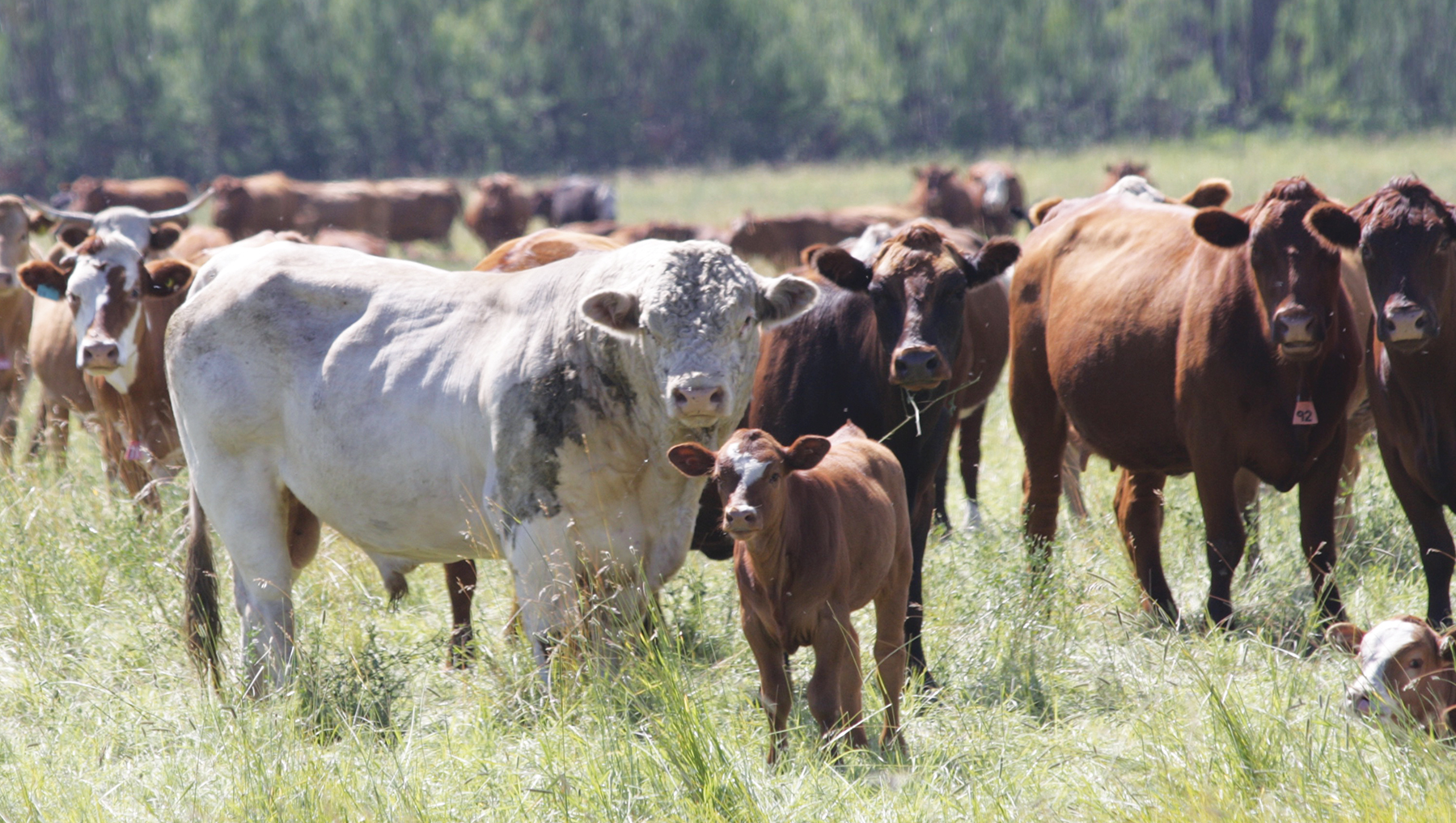
Grazing Versus Haying: Irrigated Pasture Can Be More Productive than Haying
By Heather Smith Thomas
With well-planned management, irrigated hayfields can often be more productive when utilized for grazing. Some producers are changing from haying to grazing their irrigated fields. Jeff Mosley, PhD (Department of Animal Science), Montana State University) says that in some situations grazing makes more sense.
“For example, some irrigated hayfields are irregularly shaped near streams or terrain constraints, and swathing/baling them is slow and inefficient. The cut hay near a creek may take a long time to dry before it can be baled, so regrowth is delayed while waiting to bale, and risk of getting the hay rained on increases,” says Mosley.
If irrigation depends on a stream that has less water in late summer, and the ditch was turned off to dry out the field enough to harvest the hay, there may not be enough water later to get the ground wet again for fall regrowth, and production is lost.
“Grazing is often appealing because fuel costs are less than for haying, but producers need to consider that switching from haying to grazing may require additional investments in fencing or water developments. Even if stock water is present, volume may be inadequate to meet demands of high stock densities needed to properly manage irrigated pastures. Additional fencing may be needed to avoid negative impacts to riparian areas when hay ground adjacent to creeks is converted to irrigated pasture,” he says.
“When producers switch from haying to grazing I don’t recommend they increase stocking rate at first, until they see how it goes. In general, tonnage harvested by proper grazing management of irrigated pasture is about the same as the tonnage harvested by proper hay production on irrigated hay land. Sometimes tonnage goes up with grazing, but it can also go down, since individual producers are often better at either managing grazing or managing haying,” Mosley explains.
Research In Utah
Randy Wiedmeier spent 25 years at Utah State University in Logan, working with range and forage projects. “We were trying to address some of the problems ranchers are having with public lands. We looked at ways they could extend private grazing (better use of private land) as an alternative when facing curtailments on grazing permits,” he says.
“We looked at maximizing irrigated pastures, first to determine which grasses would work best in our Great Basin and Rocky Mountain areas. We also did some work on winter grazing and were able to maintain a cow-calf pair on about one acre each year, with year-round grazing,” says Wiedmeier.
“For several years we ran tests, with cattle grazing various grass species—not just the clip tests to measure production. We used perennial ryegrass, an orchard grass, a meadow brome, and a couple of endophyte-free fescue varieties,” he says.
“We evaluated all aspects, including ease of establishment, productivity of the grass and its ability to withstand management-intensive grazing. Fescue came out the most desirable, by far. It’s not the most palatable grass and cattle will select something else if there’s other grass available, but they will eat it. We were able to harvest about 12,000 pounds of dry matter per acre for a 180-day grazing period in the Cache Valley in Utah, with tall fescues.”
Fescue is a hardy, productive grass and this is why much of the cow-calf industry in the U.S. utilizes it. “Looking at carrying capacity, we could graze a cow-calf pair (with a fairly fast-growing calf and a fairly productive cow, allowing 46 pounds of dry matter intake per cow-calf pair per day), on 1.9 acres for 180 days using management intensive grazing, moving cattle every day, utilizing poly-wire temporary fencing. The cattle were on and off the paddocks very quickly.”
Many producers don’t want to move cattle daily, but it pays off and extends grazing. “Intensive rotation will increase your carrying capacity by 40 to 50% compared with other systems. It all boils down to profit per acre,” says Wiedmeier.
“With an intensive system like this, we could easily wean a 700-pound calf in 220 days.” Calves raised on irrigated pasture are always heavier than calves raised on dry rangeland, partly because the cows milk better.
Grazing can be more profitable than putting up hay on that same land. It may also be a feasible option if a rancher’s public grazing is eliminated or reduced and you have to run the cattle at home on hayfields instead of putting up hay. “It’s the same situation all over the West. We never know from one administration to the next what will happen, or whether ranchers will be able to continue to use the range—or if the agencies will make it so difficult that some ranchers quit.”
If a person can put up seven tons per acre per year at $200 per ton for alfalfa hay, this would be $1400 per acre before you deduct the costs of irrigation, machinery, and all the other costs involved in making hay. If hay prices are lower than that, your profit per acre would be less. “By the time you take at least $600 an acre off that for growing and putting up the hay (and this estimate has increased in recent years, with inflation and higher costs of fuel, etc., you might make $800 an acre on years with high hay prices,” Wiedmeier says. If a person has to replace older machinery, this expense would take a big chunk out of the profit for haying.
There will be less profit on grass hay, which is worth less per ton, and which might make only one cutting per season (in Western climates) instead of three. “By contrast, with a cow-calf production system you might be looking at $1000 or more per acre return, depending on cattle prices,” he says.
“I was raised in an area in Montana where we put up hay all summer and fed hay all winter, sometimes from October through May. Putting up hay is always risky, with the weather. It costs just as much to put up mediocre hay as good quality hay. Pasturing takes the risks out of this equation,” says Wiedmeier.
On many western ranches, especially those with less than perfect hayfields or odd-shaped meadows along a stream, it might be more profitable raising cattle than hay. Marginal fields and pastures can be improved tremendously by intensive grazing management, greatly increasing the carrying capacity.
Grazing Experience In Idaho
Even good hay ground can be profitably grazed instead of haying. Jim Gerrish, American Grazinglands Services (May, Idaho) has been involved with innovative grazing systems for many years, and now raises cattle in eastern central Idaho, practicing these principals on his Circle Pi Ranch.
“We do daily pasture rotation with cattle on center pivots. Irrigated pasture has high production potential and the ability to regrow rapidly. We do a fast rotation, putting water back onto a strip a day or two after it is grazed. This accelerates regrowth and creates opportunity for creating another crop,” he says.
“Well-managed pasture under center pivots will meet or exceed hay production, so a person is not giving up any productivity by grazing instead of haying. You have more days of active growth,” says Gerrish. It only grows up once for hay (or twice if you have a long growing season) but you have multiple cropping with grazing.
“Most of our pastures we graze four times in a season. Compared to what is considered good hay production in our valley (which has a short growing season), on average we get 40 to 50% higher dry matter production harvesting it with livestock than what we’d get if it were all being taken as hay. This is a substantial increase,” he says. His pastures are strip grazed under the pivots.
Eagle Valley Ranch near Salmon, Idaho (recently sold to a new owner), began using management-intensive grazing about a dozen years ago, grazing cattle on irrigated forage they originally harvested for hay, and increased production per acre. Grazing adds cattle manure and also improves soil and plant growth. They moved cattle frequently, always trying to leave residual forage. If a person leaves enough leaf base it comes back a lot quicker.
If the grass is a foot high when the cows go into a pasture, they might take it down to six inches and then leave. Every pasture is different, however; some may not grow as tall and the response isn’t as quick. You have to monitor and manage. Grass grows more quickly in spring and early summer than in July/August when weather gets hot, and irrigation helps keep it growing better. Pivot irrigation is an easier way to keep things wet when it’s hot, versus flood irrigation. You can water some pastures more effectively, putting a certain amount of water on them, whereas it can be hard to get across them with flood irrigation when the water won’t go as far.
The hardest part of pasture management is knowing when to go on it with cattle. You don’t want to start too early, but if you have many acres you are trying to graze and keep it all clipped at the proper time so it will keep growing, it can be hard to time it just right. Grass is short when it’s first coming up so it’s important to not stay on it very long. You are flash grazing, giving the cattle a few bites and moving on. After that it may start to get ahead of them if you only have a certain number of cows. That’s when you could actually bring extra cattle for about three weeks. It’s always a balancing act, and the grass will always get ahead of you on a wet spring.
On one 180-acre pivot the Eagle Valley Ranch put in a clover/grass mix, and had to hay it in early summer—getting 2.5 to three tons to the acre. Then they let it grow back about eight to 10 inches tall and put calves on it after weaning, and they gained 2.5 pounds per day. That gave two good crops off that pivot.
This type of grazing does amazing things for the cattle, but most important is what it does for the grass. It provides weed control, keeping weeds eaten off (before they go to seed), and the cattle provide natural fertilizer. Concentrating the cattle, they cover that ground with manure, and then they are out of there the next day. On green feed the manure is liquid and you don’t have to harrow pastures. The grass is more vigorous and growing, and supplies good quality feed.
More Reasons To Graze
Karin Lindquist, BSc Ag (Forage/Beef Specialist in Alberta) says that when you remove the forage for hay you are exporting nutrients from the land, unless you feed that hay to cattle on the same piece of ground. “Those nutrients need to be returned, to maintain productivity. If you continually harvest hay and take nutrients from the soil, you have to add them back, with fertilizer, which is an added cost for haying,” she explains. By contrast, if cattle are grazed on that piece of land, organic matter and fertilizer are added back into the soil in the form of manure and trampled vegetation.
“Cattle return 80 to 90% of what they consume back onto the land. This seems inefficient but when cattle are mobbed up with intensive grazing and moved to new pasture frequently, each area gets an equal amount of trampling and manure to stimulate regrowth. This adds fertility and reduces the cost for purchased fertilizer, possibly to the point where it might not be needed,” she says. This depends on what the producer wants from the land, and the level of production desired. Eliminating the expense of fertilizer, however, may tip the scales toward grazing being the more profitable situation.
In most cases it doesn’t have to be a choice of haying or grazing. “A producer has the option to do both. It might not be both the same year, but it could be, especially in a good year when it grows early and quickly. You could put up one crop of hay, let it regrow, and then graze it, or you might allow it a rest from haying for a year and graze it instead,” she explains.
“If it’s a high-quality crop and there’s opportunity to custom graze stocker cattle after hay harvest, this can be a profitable second ‘crop’. You could bring in yearlings to pasture on high-quality forage for good gains on the cattle. Cow-calf pairs will also benefit, with their high nutrient requirements for milk, and gains on the calves,” she says.
A producer can custom graze for other people, or use his/her own stockers to grow or finish on grass. This is an option with a lot of potential. Irrigated pasture can produce adequate quality and quantity for finishing beef on forage.
Cattle can graze rotationally throughout the growing season and take advantage of high-quality forage at all times, making it lower risk even if the beef market is a gamble. Haying can be risky if you are trying to produce a high-quality/high-value hay crop because you are depending on timing and weather conditions. What might have had the potential to be a high-value crop may be damaged by rain and ends up being a lower-value hay. Haying is a gamble when trying for the best market.
The potential for significantly reducing the cost of machinery, maintenance, fuel, etc. is a factor when weighing the options. If your haying equipment is getting older and you are looking at the expense of replacing it, grazing might be a more attractive option.
Some people may prefer the labor involved in managed, intensive grazing, while others may consider it too much work. “Setting up electric fence, watering points, and shorter time spent moving the cattle is cheaper however, than the costs associated with haying but often it comes down to personal preference, whether you want to play in the tractor or move cows!” she says.
She recommends taking a look at your management goals, the costs involved with various options, and what kind of profit you could potentially make from that piece of ground. “It doesn’t always have to be one or the other because you can do both. Look at the opportunities you might take advantage of, whether it’s markets, or a neighbor with cow/calf pairs or stockers that need pasture.” Custom grazing can be profitable, eliminates the gamble of owning cattle yourself, and adds fertility to your soil by adding animal input instead of continually taking away soil nutrients with a harvested crop.